The Vanishing at Rue Serpente
🥀 Dark Romance
2/12/202616 min read
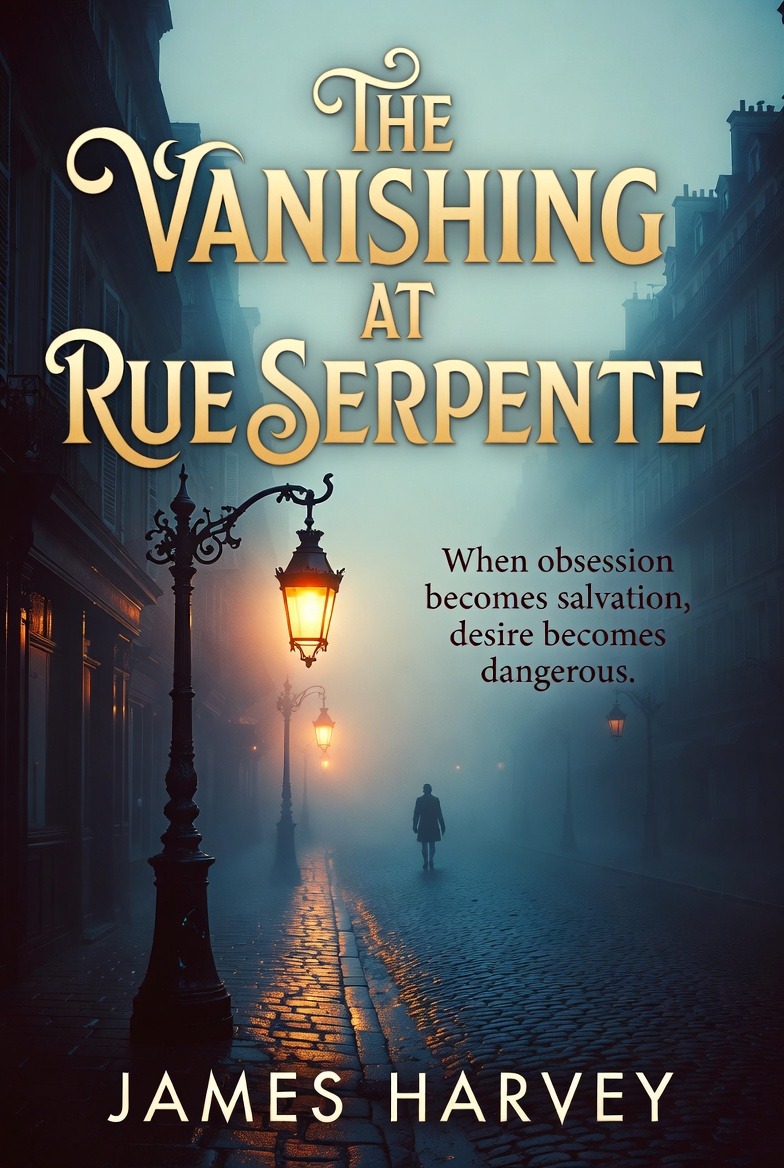
Front cover image generated by Grok using prompt created in Ideorix Publishing Section. The agent is genre aware and extracts precise details from the Story Bible in the Project to ensure the cover created is relevant to the story.
This was a 12 Chapter Novella created from this single line - utilising the Transportive Setting feature.
A lady is walking home from an artists house on a Sunday evening in Paris.
This is totally unedited - straight from Ideorix.
# Chapter 1
The scent of turpentine and linseed oil clung to Céleste's fingers like a lover's promise, refusing to wash away no matter how she scrubbed. She flexed her paint-stained hands in the lamplight of Théodore's studio, watching shadows dance across the portrait she'd just completed—a merchant's wife with kind eyes and a mouth that suggested secrets.
"Another masterpiece, *ma petite*," Théodore murmured from his cluttered desk, not looking up from the correspondence he was sorting. His weathered fingers paused over an ornate letter opener, its pearl handle catching the gaslight. The antique piece had belonged to his late wife, and he touched it now with the reverence of a man who understood the weight of beautiful, fragile things.
Céleste stepped back from the easel, wiping her hands on the paint-streaked apron tied about her waist. The portrait was good—better than good. The woman's essence lived in those brushstrokes, the way her shoulders curved with the burden of maintaining appearances whilst her eyes held dreams of something wilder. It was the sort of truth that made Céleste's art dangerous in a world that preferred pretty lies.
"Beaumont's been asking about your work again," Théodore said, his voice carefully neutral in the way that meant trouble.
The name sent ice through her veins. Vicomte Henri de Beaumont collected beautiful things the way other men collected horses or hunting dogs. She'd heard whispers in the cafés of Montmartre about his private salons, about the artists who disappeared into his patronage and emerged... changed. If they emerged at all.
"I've told you—I won't paint for him." She untied her apron with sharp, decisive movements. "I'd rather scrub floors."
"*Merde*, child, you cannot scrub floors in this neighbourhood and you know it." Théodore's laugh was bitter. "A woman alone, with your talent? The wolves would devour you before winter."
Céleste moved to the window, pressing her palm against the cold glass. Outside, fog rolled through the cobblestone streets of Montmartre like grey silk, transforming the familiar into something ethereal and strange. Gas lamps bloomed like dying stars in the murk, their light swallowed before it could travel far. Sunday evenings always brought this peculiar quiet to the quarter, as if the very air held its breath.
"Then I'll leave Paris." The words tasted like ashes. "Find somewhere that won't ask me to sell my soul for the privilege of eating."
"And abandon everything you've built? *Non*, Céleste. You're frightened, and rightly so, but don't let fear make you foolish." Théodore rose from his desk, the letter opener glinting as he set it aside. "There are other patrons. Safer ones."
But were there? In three years since her parents' death, she'd learned that safety was a luxury women of her station couldn't afford. Every commission came with expectations that went beyond paint and canvas. Every smile from a wealthy gentleman carried the weight of unspoken negotiations. She'd kept herself clean thus far through wit and stubbornness, but the walls were closing in.
"I should go," she said, already reaching for her shawl. "Marie will worry if I'm late again."
Marie Beauregard ran the boarding house where Céleste rented a cramped room beneath the eaves. The woman had a heart as generous as her cooking, but she fretted over her tenants like a mother hen. Céleste had learned to navigate those worries carefully, to time her arrivals so Marie wouldn't ask too many questions about where she'd been or whom she'd seen.
Théodore frowned at the window, where the fog had thickened to an almost solid wall of grey. "Take my umbrella. This mist has teeth tonight."
"I'll be fine. The walk is only ten minutes."
"*Stubborn girl.*" But his tone held affection. Théodore had been her father's friend in the old days, when Jean-Baptiste Dubois still painted landscapes that captured light like prayers. Now he was all the family she had left—a gruff guardian angel who smelled of paint thinner and cheap tobacco.
Céleste wrapped her shawl close and kissed his grizzled cheek. "Lock the door behind me. And don't let any well-dressed gentlemen charm their way inside."
"*Bah*. I'm too old and ugly for charm."
But his smile faded as she stepped into the corridor. She heard the lock turn behind her with a finality that sent prickles along her spine.
The fog embraced her like a living thing, cool and damp against her skin. Her footsteps echoed on the wet cobblestones as she made her way down the narrow street, past shuttered windows and doors painted in peeling blues and greens. The familiar route felt different tonight—longer somehow, as if the mist stretched distances beyond their natural boundaries.
A cat yowled somewhere in the darkness, its cry sharp and desperate. Céleste quickened her pace, her heels clicking against stone with mechanical precision. One step, two steps, breathe. The fog was so thick she could barely see her own feet, could barely make out the faint glow of the street lamps that should have guided her way.
That's when she felt it—the crawling certainty that she wasn't alone.
The sensation started as a whisper between her shoulder blades, a prickle of awareness that made her skin tighten. Someone was watching her. Someone had been watching her for some time, matching her pace with the patience of a predator.
Céleste forced herself not to look back, not to betray her awareness with sudden movement. Instead, she let her steps falter naturally, as if she were struggling to find her way in the murk. The fog muffled sound strangely, making it impossible to pinpoint the source of her unease, but she could feel eyes on her like a physical weight.
Her heart hammered against her ribs as she turned the corner onto Rue Serpente, the narrow street that would take her home. The boarding house was so close now—perhaps five more minutes through this grey maze. If she could just reach Marie's yellow door, she'd be safe.
But safety felt as distant as the moon.
The footsteps behind her were soft, almost silent, but they were there. A rhythm that matched her own with unnatural precision, stopping when she stopped, starting when she started. Professional. Practised.
*God in heaven, what do they want?*
Her breath came faster now, forming small clouds in the cool air. She thought of Théodore's warnings, of Beaumont's interest, of all the reasons a woman might disappear from Montmartre's twisting streets. Her hands clenched into fists beneath her shawl.
She could run. The thought flashed through her mind like lightning, followed immediately by its impossibility. These cobblestones were slick with moisture, treacherous even in daylight. In this fog, at this pace, she'd likely break her neck before she took ten steps.
Instead, she stopped.
The silence stretched like a held breath. No more footsteps, no sound at all except the distant drip of condensation from iron lamp fixtures. But the sensation of being watched intensified until her skin fairly hummed with it.
"I know you're there." Her voice came out steadier than she'd expected, carrying clearly in the muffled air. "What do you want?"
Silence.
Then, from the shadows behind her, a voice like silk and smoke: "Forgiveness, mademoiselle."
She spun, her shawl billowing around her, but saw only grey fog and the faint outline of a lamp post. The voice had been cultured, aristocratic—not the rough tones she'd expected from a common thief.
"Show yourself." Her chin lifted with a defiance that was pure bravado. Inside, terror clawed at her throat.
"I cannot. Not yet." The voice seemed to come from everywhere and nowhere, as if the fog itself were speaking. "But I want you to know—what happens next, it is not from malice."
*What happens next.*
The words hit her like ice water. She backed away, her heel catching on an uneven stone. "Stay away from me. I have nothing worth stealing."
A sound that might have been laughter, soft and infinitely sad. "You have everything worth saving."
Before she could process the meaning of those words, shapes moved in the fog—not one person but several, materialising from the grey like phantoms. They wore dark clothing that blended with the shadows, their faces hidden beneath the brims of their hats. Professional men, she realised with growing horror. This wasn't a random attack.
"Please," she whispered, backing against a brick wall. The rough surface caught at her shawl. "Please, I've done nothing—"
"*Mademoiselle Dubois.*" The silk voice again, closer now. "You will not be harmed. You have my word."
His word. As if honour meant anything in this grey world of fog and fear.
She opened her mouth to scream, but something pressed against her face—fabric that smelled of chemicals and roses. Her vision blurred at the edges as she struggled, her hands clawing uselessly at the arms that held her. The fog seemed to thicken around her thoughts, pulling her down into grey oblivion.
The last thing she saw before darkness took her was a figure emerging from the mist—tall, elegant, with eyes that held what might have been regret.
* * *
*Lucien Alexandre de Montclair had been watching Céleste Dubois for three months, two weeks, and four days.*
The precision of his obsession should have disturbed him. Instead, it had become as natural as breathing, as necessary as his morning coffee or evening brandy. He knew her routines better than she did—the way she bit her lower lip when concentrating on a particularly difficult passage in her painting, the manner in which she counted coins twice before making any purchase, the careful route she took through Montmartre's streets to avoid the more dangerous corners.
He knew she took her coffee black, that she hummed whilst she worked, that she had a small scar on her left hand from a childhood accident involving broken glass. He knew she was afraid of Beaumont—had seen the way she stiffened when his name was mentioned in the cafés, the way her eyes went watchful and dark.
Most importantly, he knew she was in danger.
From his position in the shadows across from Théodore's studio, Lucien had watched the light in the windows, had seen her silhouette moving against the golden glow as she worked. Even through the glass, her grace was evident—the fluid motion of her arm as she painted, the tilt of her head when she stepped back to assess her work.
She was leaving later than usual tonight. The fog was thicker too, which would make things easier for his men but more dangerous for her. Beaumont's people had been circling closer these past weeks, and Lucien's network had intercepted enough conversations to know that tonight was meant to be the end of her freedom.
The Vicomte collected beautiful, talented women the way other men collected butterflies—capturing them, pinning them down, displaying them until their beauty withered under his attention. Then he discarded them, often to fates worse than death.
*Not this one.* The thought burned through Lucien's chest with painful intensity. *Not her.*
He'd tried other methods first. Anonymous gifts of money left at her boarding house—returned unopened. Hints passed through intermediaries about lucrative commissions in safer cities—ignored. An offer of respectable employment with a colleague in London—declined with polite firmness.
Céleste Dubois was as stubborn as she was beautiful, as proud as she was vulnerable. She would not accept help, would not flee, would not compromise her principles even to save her life. It was admirable. It was infuriating.
It left him no choice.
The studio door opened, spilling lamplight across the fog-slick cobblestones. Céleste emerged wrapped in her dark shawl, her auburn hair catching the glow for just a moment before the mist swallowed her. Lucien's chest tightened as he watched her pause, as if sensing the danger that surrounded her.
*Run,* he willed her silently. *For once in your stubborn life, listen to your instincts and run.*
But she didn't run. She walked into the fog with her chin up and her spine straight, every inch the defiant artist who would rather starve than compromise her soul.
Lucien gave the signal.
His men were professionals, chosen for their discretion as much as their skill. They moved through the fog like ghosts, positioning themselves along her route with practised efficiency. Lucien followed at a distance, his heart hammering against his ribs with something that felt uncomfortably like guilt.
When she stopped and called out, her voice clear and brave in the muffled air, he almost called the whole thing off. The sound of her fear was like acid in his throat, burning away his careful rationalisations.
But then he thought of Marguerite—sweet, trusting Marguerite, who had believed the best of everyone until the very end. He thought of Beaumont's smile as he'd watched his sister's reputation crumble, of the letter she'd left before stepping in front of that carriage.
*I cannot save myself, but perhaps I can spare others this fate.*
"Forgiveness, mademoiselle," he whispered into the fog, meaning it more than she could possibly know.
The confrontation was brief, professional. Céleste fought—of course she fought—but chloroform was efficient, and his men were gentle despite her struggles. Lucien caught her as she fell, her weight slight and warm in his arms.
Up close, her face was even more beautiful than he'd imagined. High cheekbones and a stubborn chin, dark lashes fanned against pale skin, lips that were soft and generous even in unconsciousness. She smelled of paint and linseed oil, of honest work and fierce independence.
"*Forgive me*," he murmured against her hair as he lifted her into the waiting carriage. "*I will keep you safe. I swear it on my sister's grave.*"
The fog swallowed his words as the carriage rolled away into the night, carrying them both towards an uncertain future. Behind them, Montmartre slept on, unaware that one of its brightest lights had just vanished into the grey.
* * *
*Consciousness returned like sunrise—gradually, then all at once.*
Céleste's first sensation was softness. Not the familiar lumps and valleys of her narrow boarding house bed, but silk sheets that whispered against her skin like expensive promises. Her second was warmth—not the grudging heat of her small coal fire, but the deep, encompassing warmth of a room built for luxury.
The third was panic.
Her eyes snapped open to unfamiliar splendour. Above her stretched a ceiling painted with cherubs and clouds, their rosy cheeks and golden wings catching the light from what appeared to be a genuine crystal chandelier. The bed she lay in was massive, its posts carved from dark wood and hung with curtains in deep burgundy. Everything spoke of wealth, of aristocratic comfort, of a world she'd only glimpsed in paintings.
Céleste sat up slowly, her head swimming with the aftereffects of whatever they'd used to subdue her. The movement sent her hair tumbling over her shoulders—someone had unpinned it whilst she slept. The realisation sent fresh terror through her veins.
*What else had they done whilst she was unconscious?*
A quick inventory revealed her clothing intact, though her shawl was gone and her dress had been carefully arranged to prevent wrinkles. Her shoes sat neatly beside the bed, as if placed by a considerate host rather than a kidnapper.
The room itself was a study in elegant contradictions. Beautiful, but clearly a prison—she could see heavy bars worked into decorative patterns across the windows. Luxurious, but cold—no personal touches, nothing to suggest this space belonged to anyone in particular.
Céleste swung her legs over the side of the bed, testing her strength. The drug had left her muzzy and unsteady, but functional. She padded barefoot to the window, her feet sinking into carpet thick enough to muffle all sound.
Beyond the glass lay a courtyard garden, immaculately maintained but empty of life. High walls surrounded it on all sides, topped with decorative ironwork that would be impossible to climb. In the distance, she could see the rooftops of Paris, but nothing that would help her identify her location.
"You're awake." The voice from the doorway was silk and smoke, the same voice that had spoken from the fog. "I confess I'm relieved. Chloroform can be... unpredictable."
Céleste spun, her back pressed against the cold window glass. The man who entered could have stepped from one of her paintings—tall and lean with the kind of aristocratic bearing that spoke of generations of breeding. His hair was dark with silver at the temples, his face all sharp angles and intelligent eyes. He wore evening clothes with casual elegance, as if kidnapping young women was merely another social engagement.
But it was his eyes that caught her—grey as the fog that had hidden her abductors, and filled with something that might have been regret.
"*You*," she breathed.
He inclined his head in a gesture that managed to be both polite and mocking. "Comte Lucien de Montclair, at your service. Though I realise the circumstances make such courtesies somewhat absurd."
"Let me go." The words came out steady, proud. Her parents had raised no coward.
"I cannot." He stepped further into the room, and she noticed he left the door open—a gesture that was either supremely confident or surprisingly considerate. "Not yet."
"Why?" The question burst from her lips before she could stop it. "What do you want from me?"
Something flickered across his face—surprise, perhaps, or approval. "You don't weep or faint or demand to know where you are. Most women would."
"I am not most women." Her chin lifted with familiar defiance. "And you haven't answered my question."
A smile ghosted across his lips, there and gone so quickly she might have imagined it. "No, you are certainly not most women. As for what I want..." He moved to a chair positioned near the window, settling into it with fluid grace. "I want to keep you alive."
"Alive." She stared at him, trying to read the truth behind those grey eyes. "You kidnap me to keep me alive?"
"Yes."
The simple certainty in his voice was somehow more frightening than threats would have been. This man believed utterly in his actions, which meant he would not be easily swayed or reasoned with.
"That makes no sense," she said carefully.
"Doesn't it?" He leaned back in his chair, studying her with unsettling intensity. "Tell me, *mademoiselle*, what do you know of the Vicomte de Beaumont?"
The name hit her like a physical blow. She saw it register in his eyes—the way her colour drained, the involuntary step backward.
"I see you know enough." His voice gentled slightly. "He has been asking about you, Céleste. May I call you Céleste?"
"You may not." The response was automatic, a small assertion of control in a situation where she had none.
"*Mademoiselle* Dubois, then." Another of those ghost smiles. "Beaumont has been making inquiries about your work, your habits, your... availability. My sources suggest he intended to make you an offer tonight that would have been impossible to refuse."
"So you decided to make me a different offer that's equally impossible to refuse?"
"I decided to remove you from the equation entirely." He rose from his chair with predatory grace. "Beaumont collects beautiful things, Céleste. He displays them in his private salon until their novelty fades, then... discards them."
The way he said 'discards' made her stomach turn. "How do I know you're any different?"
"You don't." The honesty was brutal and somehow reassuring. "But I give you my word as a gentleman that you will come to no harm under my protection."
"Protection." She laughed, the sound sharp and bitter in the elegant room. "Is that what you call this? Kidnapping? Imprisonment?"
"I call it necessary." His mask slipped for just a moment, and she glimpsed something raw beneath—pain, perhaps, or old fury. "I have seen what happens to women who fall into Beaumont's hands. I will not see it happen to you."
"Why?" The question escaped before she could stop it. "Why do you care what happens to me?"
He was quiet for so long she thought he wouldn't answer. When he finally spoke, his voice was barely above a whisper.
"Because three years ago, I failed to protect someone who mattered to me. She died because I was too proud, too trusting, too foolish to see the danger until it was too late." His eyes met hers across the room, and she saw something in them that made her breath catch. "I will not fail again."
The silence stretched between them, heavy with unspoken truths. Céleste found herself studying his face, looking for lies or madness or the cold cruelty she'd expected. Instead, she saw a man haunted by ghosts she couldn't name.
"She was your wife?" she asked quietly.
"My sister." The words fell like stones. "Marguerite. She was... she was everything good in the world. Gentle and trusting and beautiful, and Beaumont destroyed her as thoroughly as if he'd put a gun to her head."
Understanding dawned, terrible and complete. "And you think I'm like her."
"No." His gaze intensified. "I think you're nothing like her. Marguerite was lamb sent amongst wolves. You..." He paused, seeming to choose his words carefully. "You have claws. But that won't save you from him. If anything, it will make the hunt more appealing."
The truth of it settled in her stomach like lead. She had heard enough whispers, seen enough women disappear from the quarter, to know he wasn't lying. Beaumont was a predator, and she had somehow attracted his attention.
"So what now?" She was proud that her voice remained steady. "You keep me here forever? A bird in a gilded cage?"
"I keep you here until it's safe. Until I can find a way to remove Beaumont's interest or..." He didn't finish the sentence.
"Or eliminate Beaumont himself." The words hung in the air between them like a challenge.
"Or that, yes."
She stared at him, this elegant stranger who spoke of murder with the same casual tone other men used to discuss the weather. "You would kill for me? Someone you don't even know?"
"I would kill to prevent another woman from suffering as my sister did." His correction was subtle but important. "You simply happen to be the woman in question."
It wasn't romantic. It wasn't even personal. But it was honest, and somehow that honesty was more reassuring than pretty lies would have been.
"I want to see this room you've prepared for me," she said finally. "All of it. I want to understand exactly what sort of cage you've built."
He nodded, rising to his feet. "Of course. Though I think you'll find it more comfortable than most cages."
As he moved toward the door, she caught sight of something that stopped her cold—a painting on the far wall, partially hidden by shadow. Even from across the room, she could see the skill in the brushwork, the way light played across the subject's face.
It was a portrait of a young woman with kind eyes and flowing hair, painted with a lover's attention to detail. But it was the expression that made Céleste's breath catch—joy and trust and terrible, tragic innocence.
"Marguerite," she whispered.
Lucien's step faltered. "Yes."
"You painted her."
"I did." His voice was carefully neutral. "Before I knew what the world would do to her."
Céleste moved closer to the painting, studying the technique with a professional eye. The work was masterful—technically perfect and emotionally devastating. But it was also unfinished, as if the artist had been unable to complete his vision of innocence preserved.
"She was beautiful," Céleste said softly.
"She was destroyed." The words were harsh, final. "Beauty made her a target. Kindness made her vulnerable. Trust made her a victim."
"And you think the same will happen to me."
"I know it will, if Beaumont gets his hands on you." He turned away from the painting, his shoulders rigid. "Come. Let me show you the rest of your accommodation. Perhaps you'll understand why I prefer to call it sanctuary rather than a cage."
As she followed him from the room, Céleste caught one last glimpse of Marguerite's painted face. The girl in the portrait seemed to watch her go with eyes full of warning—or perhaps pity.
Either way, Céleste realised with growing certainty, her old life was over. Whatever came next would be played out in this elegant prison, with this haunted man who painted tragedy and spoke of murder like salvation.
The thought should have terrified her. Instead, as she walked beside him through corridors hung with priceless art, she felt something that might have been anticipation stirring in her chest.
After all, hadn't she always been drawn to dangerous beauty?
Contact
Reach out anytime, using the contact form
CONTACT IDEORIX USING THIS FORM:
© 2025 James Harvey Media. All rights reserved.